Webring

Member of the NEW TRAJECTORIES webring

Showing posts with label Bucky Fuller. Show all posts

Wednesday, November 02, 2016

Maybe Bucky would feel impressed

A Japanese design company has come up with an elegant solution to the problem that Bucky solved with his Dymaxion Map, of showing the countries and continents of Earth so that all were correctly scaled (unlike most of the maps we may feel familiar with (The Mercator, The Peters, etc).

Even better, using principles of origami, they have made it so that it can actually be made into a globe!

You can find all the details about how they figured it out on their website, here.

They certainly acknowledge their debt to Bucky's original work (you can see his Dymaxion map on page 3 of their explanation) - but in some ways their map looks less odd than Bucky's (which can also be folded into a near globe).
Bucky's Dymaxion Map


Tuesday, March 15, 2016

In the Outlaw Area

Back in January 1966, the New Yorker published this extended conversation with Bucky Fuller, written by Calvin Tomkins.   It avoids that sensation of difficulty/complexity that arises from some of Bucky's own writing, and gives an affectionate and lucid description of spending time in Bucky's company, and his endlessly intriguing and amusing conversation on a wide range of subjects (or rather, of inter-related aspects of Universe).


Talking of teaching himself maths:

“Later on, we came to geometry. The teacher made a point on the blackboard, then erased it and said, ‘That doesn’t exist.’ She made a row of points, and said, ‘That’s a line, and it doesn’t exist, either.’ She made a number of parallel lines and put them together to form a plane, and said it didn’t exist. And then she stacked the planes one on top of the other, so that they made a cube, and she said that existed. I wondered how you could get existence out of nonexistence to the third power. It seemed unreasonable. So I asked her, ‘How old is it?’ The teacher said I was just being facetious. I asked her what it weighed and I asked how hot it was, and she got angry. The cube just didn’t have anything that I thought was existence, but I thought I was probably being unfriendly, and so I shut up. I got A’s in all my science work, and when I got to Harvard I didn’t go on with mathematics, because it was so easy—just a sort of game you played. I thought I’d take something really difficult, like government or English."

Hat tip to Bobby Campbell for this image
"There is no doubt whatever in Fuller’s mind that the whole development of modern science and technology has resulted from a willingness on the part of a very few men to sail into the wind of tradition, to trust in their own intellect, and to take advantage of their natural mobility. According to Fuller, the influence of this tiny minority, the navigator-priests of pre-history who ventured into the outlaw area and returned with the new wealth that was knowledge, was always far greater than that of the kings or other rulers to whom they were officially subject, and the situation is no different today; it is modern technology, rather than political leadership, that directs the real movement of contemporary history. “Take away the energy-distributing networks and the industrial machinery from America, Russia, and all the world’s industrialized countries, and within six months over two billion swiftly and painfully deteriorating people will starve to death,” he has written. “Take away the politicians, all the ideologies and their professional protagonists from those same countries and leave them their present energy networks, industrial machinery, routine production, and distribution personnel, and no more humans will starve nor be afflicted in health than at present.”


Much earlier, he wrote a collection of pieces, worth tracking down if you can find a copy, called "The Bride and the Bachelors: Five Masters of the Avant-Garde" - with insightful descriptions of Duchamp, Tinguely, Cage, Rauschenberg and Cunningham.

You can find a free PDF of The Afternoon Interviews here.

Sunday, July 12, 2015

Happy Birthday, Bucky!


From The Huffington Post

Why I/We Celebrate Buckminster Fuller's Birthday (July 12, 1895) Every Year  
by L. Steven Sieden

"So I vowed to keep myself alive, but only if I would never use me again for just me. I vowed to do my own thinking, instead of trying to accommodate everyone else's opinion, credos and theories. I vowed to apply my own inventory of experiences to the solving of problems that affect everyone aboard planet Earth."

In contemplating this commitment, I have found it extremely similar to the Buddhist Bodhisattva Vow, and many people contend that Bucky was in fact a living Bodhisattva wearing a three-piece suit in order to not stand out from his contemporaries. Regardless of his appearance, his mission became clearer and clearer until he honed it down to the following simple yet powerful sentence:

"To make the world work for 100 percent of humanity in the shortest possible time through spontaneous cooperation without ecological damage or disadvantage to anyone."

Click pic for article in Art Tatler

How R. Buckminster Fuller Committed “Egocide”  by Agathe Molvic in The Utopian


Wednesday, November 27, 2013

Who knew?

This blog, as a fan of Bucky Fuller, has more than once referenced his Dymaxion Map of Planet Earth, and it  has some undoubted virtues over standard maps.

However, we just stumbled over an early challenge to it, that does deserve a viewing - Cahill's Butterfly.

Read the details on Wired, at:

Projection Smackdown: Cahill’s Butterfly vs. the Dymaxion Map

Thursday, February 02, 2012

A hopeful sign?

Quite a few years ago now the visionary and engineer, Bucky Fuller, suggested that if we shared Spaceship Earth (as seen from space) like a unified crew, then we could most effectively use the energy available to us to advantage everyone:

"How do we make the world work for 100% of humanity in the shortest possible time through spontaneous cooperation without ecological damage or disadvantage to anyone?"

He got dismissed as politically naive and optimistic to assume we could shed the artificial boundaries of nation states, and conflicts of interest, but he always pointed out that once it became economically evident that it would prove useful and efficient, the idea would start to look good.  He even calculated time periods for how long it took for new ideas to get adopted in different aspects of human life.

One of the grand unifying ideas that impressed me involved linking the electrical networks of the USSR (as was) with that of the USA.  Surplus energy generated in the day side of the planet would heat and light the night side of the planet, indefinitely. 

Of course, the illusion of separation and distance of 'East' and 'West'  created by the Greenwich-centred Mercator and Peters projection maps in use made it seem unfeasible to many


but looking at it another way, it turns out the US/Canadian continent, and the Russian/Asian continent almost touch (something like 30 miles apart) so the engineering aspect of the plan has much going for it. 

Any spherical globe can demonstrate this, but Bucky's Dymaxion maps make the idea more vividly realistic (to my eyes).

Global Energy Network Institute

I have no idea what timescale Bucky put on the adoption of this idea, but perhaps recent news could prove a sign that the change has started to look inevitable, essential...

Iran, Iraq, Pakistan Interconnecting Their Electric Grids

China Completes Cross-Border Power Transmission Project With Russia

Hell, if you don't like Bucky's map, even a Mercator projection centred on the USA (with Russia to the West) can show how easily the continental gap could be bridged...


Tuesday, July 12, 2011

Happy Birthday Bucky!

McLuhan and Bucky Fuller
Bucky did sometimes imply that McLuhan had got quite a lot of his radical ideas from Fuller's own work...he doesn't seem to have born a grudge...

Thursday, December 16, 2010

Only if you want to...


A lot of our readers may well fall into the 'starvin' artist' category, so we just wish you a cool season, but for anyone with spare gift money, looking for a good cause...The Bucky Fuller Institute (a non-profit) need to reach $25000 by the end of the year to stay solvent, and have so far got $14,500.

If you do like the idea of supporting a worthwhile group of researchers, then maybe consider this...worth a visit, anyway, to see what they get up to...

Bucky Fuller fund-raiser

Thursday, December 09, 2010

Spatial Thinking

Bucky time seems to have arrived (no doubt he predicted about how long it would take for his ideas to reach their moment - he always appeared aware of how long it would take for new ideas to become obvious, depending on the field of study).

He seems to have used visualisation as a way to approach the world, and whether you think it stimulates holistic thinking (whole-istic?), or the right brain (or the cerebellum as Stan Gooch controversially suspected) these meditational devices may feel to you as inspirational or soothing, fascinating or simply beautiful.

This one appears on Grunch.net here


By Chardhawk (or can we assume that means by Richard Hawkins & Kirby Urner?)

Anyway, Synergetics on the Web (definitely attributed to Kirby Urner) might intrigue you for a while...


"The brilliant manner in which Fuller fused the development of a revolutionary structural system, the geodesic dome, out of a combination of many hundreds of paper and cardboard geometrical models that were ostensibly intended to be analogical aids for a system of thought, deserves careful consideration. Perhaps the best explanation of it is offered by his 1989 biographer Lloyd Steven Sieden.

'Thinking is sorting experiences’, writes Sieden at the beginning of his exposition of Fuller’s approach, ‘Separating the huge set of experiences that are irrelevant from the very small set of experiences that are relevant’. But irrelevant material itself falls into two categories, and Fuller believed that imagining thought as a transparent sphere helped him to see a way of distinguishing between them. He visualized a situation in which all irrelevant experiences that were too small and too frequently occurring were inside the imaginary sphere, and all those that were too large and too infrequently occurring could be regarded as outside it.

The way Fuller imaged the thinking process, the surface of the imaginary sphere itself would then only consist of relevant experiences, or thoughts. He then wondered how many relevant experiences it would take to establish the ‘insideness’ and ‘outsideness’ necessary to create a sphere of thoughts. His answer was that while any two experiences could be joined by a line, it too three to fix their relationship – a concept perhaps not dissimilar to the journalistic principle that it takes three events to make a trend. This point Fuller diagramatized by drawing a triangle. But to establish a sphere containing ‘insideness’ and outsideness’ something robust enough to be called a thought, was impossible using flat triangles on paper, because the triangle had no integral space-enclosing depth. Three-dimensional structure, in thought as in geometry, could only be achieved by plotting in a fourth experience. The resulting three-dimensional model, a three-sided pyramid, or tetrahedron, Fuller came to believe, was the true geometrical model of a thought. It consisted of four points, or experiences, which in turn generated six sides, or relationships."


from p122 of Martin Pawley’s little book on Bucky

Hey, feeling child-like? Try this Bucky4kids site - why not?

you'll find all sorts of fans out there...this website hasn't updated since 2006, but might prove worth a visit...

"The whole world has to be turned into music or into a Fuller university." John Cage

Sunday, February 24, 2008

Just a coincidence!

If you read the extended Comments on the previous post, you will know that Ben Mack shares a respect for RAW (Robert Anton Wilson) and Bucky Fuller, and others that this blog references (like Hakim Bey, or Kurt Vonnegut) - and for honesty in communication.

Poker Without Cards

For fellow MLA students interested in treating Poker Without Cards as a text for our Reading Group, but who feel resistance to Ben as a ‘marketeer’ – I recommend taking an hour to watch/listen to this interview. The book does not refer to all his thinking, but covers a period when BM found himself incarcerated in a mental institution after a breakdown, and got casually informed that he ‘was’ a paranoid schizophrenic. Later that diagnosis got retracted (because he rebuilt himself in a way that someone with that diagnosis couldn’t have done). He didn’t receive any kind of apology. It brings to mind Timothy Leary’s incarceration for ‘dangerous thinking’ – and also the approach that R.D.Laing took to people in similar states of mind, back in The Sixties.

Go to Grey Lodge for a pirate PDF edition Or Second Attention.
[spoiler alert: Lulu Review of the book]

You could also research Ben Mack’s marketing lectures (1h20m), and books, and stuff, but that might set off your prejudices. Some of us have remarked on the fact that he set up a website entitled “What Would Bill Hicks Have Said”, and have countered it with Bill’s quotes about people in advertising. Well, BM makes a distinction (in this video) between marketing and advertising. I leave you to tease out the distinction. Having nothing in particular I wish to sell, I don't know how he can help me with his seminars (I don't even have much desire to 'make more money') but if he can use all those skills to get fresh drinking water to everyone on the planet, then I think he deserves all the support he can get. (rant over)

Genius comes in many forms
The cause is hidden, the results well-known
It seems that BM counts as some kind of ‘genius’ and they sometimes prove uncomfortable as companions, and often get 'misunderstood'. Think of Orson Welles, maybe.

Please bear in mind that what I write here remains a personal opinion, and not a ‘policy statement’ that the MLA Admin supports – this blog has no direct affiliation with the management group of MLA or RAW’s literary estate. You can see it as a critical fanzine if you like.

The Maybe Logic Academy

The Maybe Logic Academy attracts people fascinated by a wide range of subjects and approaches (magick, NLP, intelligence increase, conspiracy theory, psychosomatic medicine, creativity, etc) – we don’t always agree, but we got given one rule (just the one) by RAW when he set this place up online where we could study with him (and other tutors), and interact with each other - and which forms some kind of legacy.

If you can’t achieve tolerance, at least attempt courtesy.

Such an approach to debate still seems rare (if not unique!) in online discussion spaces, and remains one of the reasons that I still spend many unpaid hours promoting and supporting it (even with the current incarnation of the forum 4.0, which has bugs which annoy some of the participants).

I have failed several times in my own attempts at courtesy, especially around the area of magic/magick (which Ben lucidly elucidates in the interview), but have learned from that, and continue to attempt to improve my communication.

Please do not find any significance in the fact that my avatar shares initials with Ben Mack! I remain an entirely separate entity. It’s just a coincidence, just a coincidence (repeat this mantra after me “It’s just a coincidence!”)

PS: This seems like a good place to throw a link to Bobby's summary of Rushkoff's Technologies of Persuasion course - over at DeOxy.

Monday, January 14, 2008

"Tomorrow is our permanent address"

McLoon and Bucky One of the things I most regretted about not having the complete Tale of The Tribe course with Bob - we never really got to discuss Marshall McLuhan.

He seems well out of fashion. For all his analysis of media, he probably appears difficult. Partly because of his teasing approach - trying to make you think!

Bobby has offered the complete version of McLuhan's Wake (with Laurie Anderson doing narrator). [but note Glandmaster's technical comment below, about the site].

I choose to watch/listen to it right now as I write. I'll probably go and buy it, so I can show it on friends' DVD players (you see! We do end up buying things, even when we can look at it online). Oh, yeah - you have to set 90 minutes aside, like a docu-movie.

In the 60s he amused me greatly. He seemed as good as Dylan at winding up journalists. He gave great soundbyte...he got slogans. He apparently gave Leary "Turn on, tune in, Drop out" (or the idea for it).

English teachers often seem to have done far more than teach one simple subject (mine did, for sure - he even understood why I had to drop out, and even wished me luck - unlike all the other teachers). I didn't know he came from a Roman Catholic position (I have my own prejudices - most of my heroes seem like lapsed Catholics - Leary, RAW, Lilly, Joyce, etc). I can't read Lord of the Rings for just that subtext from Tolkien. I didn't know it when I tried to first read it in 1972. I just felt mysteriously ill, and queasy, as I do with the Harry Potter books (which seem curiously old-fashioned with their boarding schools and 'magic powers' - but, as so often, I feel quite out-of-synch with many people. Apparently UK citizens have turned religious again, just to get their kids into the best schools. (sigh)

-There are no passengers on Spaceship Earth. We are all crew.
Marshall McLuhan
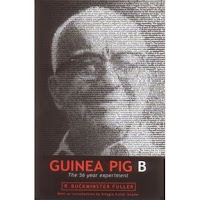
Guinea Pig B
“How can we make the world work for 100 percent of humanity in the shortest possible time through spontaneous cooperation without ecological damage or disadvantage to anyone?” — R. Buckminster Fuller

Check out John Cage talking about both of them.

McLuhan seemed curiously old-fashioned and straight, and also 'hip' at the same time. A great teacher. Whether he really 'stole' a lot of it from Bucky and Korzybski still seems an open question - perhaps we might call him a populariser.

The Phantom Captain
(click to read whole article quoted below)


But there is some evidence that this idea of the extension of man, identified by many as the core concept of McLuhan's philosophical stance, may have come from the transcendentalist Bucky. From 1960 to 1970, Constantin Dioxides, an engineer, architect, and urban planner and the founder of the Athens Technological Institute in Greece, organized summer cruises complete with cutting edge guests such as Margaret Mead, and Jonas Salk.


Many, including McLuhan, were guests more than once, but only Fuller was invited on every single trip for twelve years in a row. In The Synergetics Dictionary, under McLuhan, notes such as these were made by Fuller: "Marshall McLuhan told me the first day he met me - on one of the early Dioxide cruises - 'I am your disciple.' He held up copies of No More Secondhand God and Nine Chains to the Moon and said to me 'I've joined your conspiracy!"'
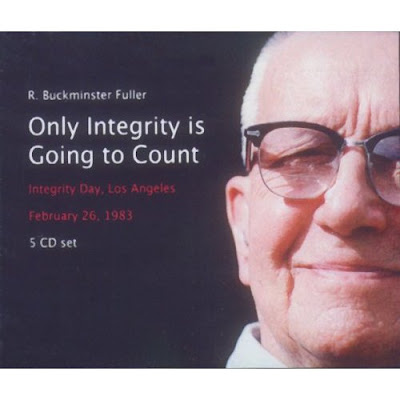

Only integrity is going to count

In his notes, he writes: "McLuhan has never made any bones about his indebtedness to me as the original source of most of his ideas. The 'Global Village' was indeed my concept. I don't think he has an original idea. Not one McLuhan says so himself. He's really a great enthusiast, a marvelous populariser and teacher. He has an irrepressible sense of the histrionic, like no one I've known since Frank Lloyd Wright."


Indeed, in Nine Chains to the Moon, a passage reads: "Through the leverage gained by his inanimate instrument extensions of self, he has attained an extended mechanical ability far in excess of his own integral mechanical energy content ability." He goes on to claim that the idea of "man backing up into his future" appears in his books and that Fuller's concept of the "Mechanical Extensions of Man" is the basis for McLuhan's talk of the "Electrical Extensions" of man.

Open source - interesting and relevant post...

At that time, I was cavorting with known anarchists like the composers John Cage and Udo Kasemets. I had been a fan of Cage, Bucky Fuller, Marshal McLuhan and William S. Burroughs since my teens; in retrospect, I was probably a powderkeg in search of a terrorist. As an unabashed advocate of free and unfettered information sharing, free software appealed to my young mind, it held an almost Kabbalistic hope: "You may pay for knowledge, but you should never charge for it.". Community currencies would prevail over the economics of scarcity; I devoted myself to learning, promoting and participating in the Free Software Revolution.

Wednesday, April 04, 2007

Spring in the Northern Hempisphere

Regular visitors may notice we have tweaked a few things, to reflect the changes in how the Maybe Logic Academy and its members present themselves to the world. Like the Masons, we could now call ourselves a society with secrets, but not a 'secret society' (heh heh).

In the links on the right hand side of the page you will now find 'latest posts' from the main forum - as well as links to the MQ magazine, the main forum (MLA 4.0 public area), a fantastic archive of RAW material - RAWilson Fans - as well as starter links to some of our favourite subject matter, from General Semantics to Bucky Fuller to Charles Fort to James Joyce, etc, and a rather erratic index of some-but-not-all (sombunall) of the content we have generated over the last couple of years.

Welcome, and please feel free to chat to us, through Comments. We like feedback...

Wednesday, February 01, 2006

Systemantics

last year, when we set this blog up, I also made a 'sandpit' blog in parallel, where we could try things out. In June 05 I posted the text below in that alternative universe, but didn't follow up on it. As I consider this blog intermediate between the permanent publication of Maybe Quarterly, and the semi-private interaction and discussions in the MLA forum, I thought I would repost the notes, to invite any feedback towards finalising a piece for the Spring MQ, and to share the links I have found.
Disclaimer: WORK-IN-PROGRESS (scroll on)

Analog and Digital Systems

Whole Systems - ecological systems

Open and Closed Systems

8 system (circuit) Model ETC.

Here you can find a list of some of the most influential people in the systems field - I have a particular soft spot for Bateson, von Bertalanffy, Watzlawick, Prigogene, Bucky Fuller and Shannon.

Oh, and Mr Korzybski's General Semantics:
"The origin of this work was a new functional definition of 'man', as formulated in 1921, based on an analysis of uniquely human potentialities; namely, that each generation may begin where the former left off. This characteristic I called the 'time-binding' capacity. Here the reactions of humans are not split verbally and elementalistically into separate 'body', 'mind', 'emotions', 'intellect', 'intuitions', etc., but are treated from an organism-as-a-whole-in-an-environment (external and internal) point of view. This parallels the Einstein-Minkowski space-time integration in physics, and both are necessitated by the modern evolution of sciences. - Alfred Korzybski

Ludwig von Bertalanffy worked on General System Theory - International Society for the System Sciences

Watzlawick makes me laugh. Shannon made juggling machines, so I have to love his mind. Bateson, as a grand master, often displayed the difficulty of thinking about systems in the Aristotelean language of Either/Or, and would mumble self-referentially about preferring Both/And [I may have made that up, but Niels Bohr famously mumbled when asked to explain his model of the universe - I heard that on the radio, so it must have some truth (!)] Prigogene turned me onto chaosmics (Joycean word) or, how order can spontaneously (almost inevitably) arise out of disorder without some Great Architect in the Sky having anything to do with it.

I find 'general models' interest me most. A few Quotes to indicate what I mean.

A lot of work on 'whole systems' belong in the ecological realm

And, of course, as buzz words they may simply turn up in sales pitches in Google

This page seems like a good place to start, if you don't know much about the subject
And you can find a great book list here

Oh, yeah. Systemantics comes from John Gall, who wrote a rather witty book with that title - still available from Amazon, etc - I believe - or the General Systemantics Press.

One's Own View of Reality as the Only Reality is the Most Dangerous of All Delusions.
"As I have already said, the belief that one's own view of reality is the only reality is the most dangerous or all delusions. It becomes still more dangerous if it is coupled with the missionary zeal to enlighten the rest of the world, whether the rest of the world wishes to be enlightened or not. To refuse to embrace wholeheartedly a particular definition of reality (e.g. an ideology), to dare to see the world differently can become a think crime' in a truly Orwellian sense as we get steadily closer to 1984." Watzlawick