Webring

Member of the NEW TRAJECTORIES webring

Showing posts with label Duchamp. Show all posts

Tuesday, March 15, 2016

In the Outlaw Area

Back in January 1966, the New Yorker published this extended conversation with Bucky Fuller, written by Calvin Tomkins.   It avoids that sensation of difficulty/complexity that arises from some of Bucky's own writing, and gives an affectionate and lucid description of spending time in Bucky's company, and his endlessly intriguing and amusing conversation on a wide range of subjects (or rather, of inter-related aspects of Universe).


Talking of teaching himself maths:

“Later on, we came to geometry. The teacher made a point on the blackboard, then erased it and said, ‘That doesn’t exist.’ She made a row of points, and said, ‘That’s a line, and it doesn’t exist, either.’ She made a number of parallel lines and put them together to form a plane, and said it didn’t exist. And then she stacked the planes one on top of the other, so that they made a cube, and she said that existed. I wondered how you could get existence out of nonexistence to the third power. It seemed unreasonable. So I asked her, ‘How old is it?’ The teacher said I was just being facetious. I asked her what it weighed and I asked how hot it was, and she got angry. The cube just didn’t have anything that I thought was existence, but I thought I was probably being unfriendly, and so I shut up. I got A’s in all my science work, and when I got to Harvard I didn’t go on with mathematics, because it was so easy—just a sort of game you played. I thought I’d take something really difficult, like government or English."

Hat tip to Bobby Campbell for this image
"There is no doubt whatever in Fuller’s mind that the whole development of modern science and technology has resulted from a willingness on the part of a very few men to sail into the wind of tradition, to trust in their own intellect, and to take advantage of their natural mobility. According to Fuller, the influence of this tiny minority, the navigator-priests of pre-history who ventured into the outlaw area and returned with the new wealth that was knowledge, was always far greater than that of the kings or other rulers to whom they were officially subject, and the situation is no different today; it is modern technology, rather than political leadership, that directs the real movement of contemporary history. “Take away the energy-distributing networks and the industrial machinery from America, Russia, and all the world’s industrialized countries, and within six months over two billion swiftly and painfully deteriorating people will starve to death,” he has written. “Take away the politicians, all the ideologies and their professional protagonists from those same countries and leave them their present energy networks, industrial machinery, routine production, and distribution personnel, and no more humans will starve nor be afflicted in health than at present.”


Much earlier, he wrote a collection of pieces, worth tracking down if you can find a copy, called "The Bride and the Bachelors: Five Masters of the Avant-Garde" - with insightful descriptions of Duchamp, Tinguely, Cage, Rauschenberg and Cunningham.

You can find a free PDF of The Afternoon Interviews here.

Thursday, January 17, 2013

Dancing Around Duchamp

A series of events and exhibitions celebrating the life and influence of Marcel Duchamp will take place in London, England - at The Barbican Centre.


"This spring the Barbican embraces chance, provocation and humour in an international season celebrating Marcel Duchamp, widely considered the father of conceptual art and the most influential artist of the 20th century. We invite you to explore work by his precursors, collaborators and the generations of artists he has influenced across art, music, dance, theatre and film."

There will be an exhibition - The Bride and the Bachelors: Duchamp with Cage, Cunningham, Rauschenberg and Johns - of painting, sculpture, stage sets and musical notations...

You will be able to see/hear a programme of Cage music and Cunningham dance.

The theatre will present pieces by Jarry, Ionesco and Beckett, etc.

The cinema will show films by  Hans Richter, Man Ray, John Cage and Jean-Luc Godard, plus silent comedy and movies from the American underground.

-0-                                                       

You can find an excellent animated website called Making Sense of Marcel Duchamp online...

#duchamp2013 for Twitter updates.

Saturday, August 18, 2007

The Trip (a trap)

Trébuchet
I have no idea how many visitors we get ("LOOK OUT! Mind that thing on the floor!") and/or how many return, and/or how many simply pass through. This blog doesn’t represent the Admin side of the Maybe Logic Academy but belongs to a bunch of ‘students’ who like to spread the word of a fun place to hang out, and share their (sometimes) obscure and esoteric interests.

As you can see from this post last October, among the people who ‘study’ at MLA you will find all sorts of creatives (writers, musicians, artists, etc) as well as philosophical folk, people into magick, or gardening, or Reichian work, etc.

As the Maybe Logic Academy originally started so that people could attend seminars and courses with Robert Anton Wilson without him (or them) having to travel around the world, that original flavour pervades throughout – but new tutors have come on board, and RAW has left the planet, so changes seem inevitable.

The MLA quarterly magazine may give a more balanced view of the range of our group interests, but this blog reflects a rather narrow cross-section of the student body…and in particular my own little reality-tunnel containing Zenarchy, Duchamp and conjuring, etc, which may display my ageing brainmind, and might well leave the other contributors quite cold.

To misquote the Principia:

Not Bob Dobbs from the back "Everybody understands Mickey Mouse. Few understand Herman Hesse. Only a handful understood Albert Einstein. And nobody understood Marcel Duchamp."

[side trip]
With apologies to
Emperor Norton - and if you haven’t heard of him, or The Discordians, try this site.
Emperor Norton
Here’s someone
following the trail

I first heard of him [Emperor Norton] from reading the Principia Discordia, written by the Joshua Norton Cabal of the Discordian Society. Their motto is: "Everybody understands Mickey Mouse. Few understand Herman Hesse. Only a handful understood Albert Einstein. And nobody understood Emperor Norton." The Discordian Society is sometimes called "nonsense disguised as religion or vice versa."
[ahem]

About Marcel Duchamp:
from A CRITICAL HISTORY OF 20TH-CENTURY ART
by Donald Kuspit
Chapter 2, Part 3 Spiritualism and Nihilism: The Second Decade


In 1917 he made Fountain, a urinal purchased from "Mott Works," a New York plumbing company, and signed "R. Mutt" (not only an ironical misspelling, suggesting that the artist is a mongrel dog or stupid person, but, as has also been thought, a play on the German word "Armut," meaning poverty). That same year he made Trébuchet (Trap), in chess a term for a pawn placed to 'trip' an opponent's piece. (Duchamp supposedly retired from art making in 1923 to devote himself entirely to chess, becoming a champion.) The work was a coat hanger which Duchamp nailed to the floor of his New York studio, where visitors could trip over it.
A Trebuchet
Actually, and more interestingly to Lasagna flingers, 'Trebuchet' can also describe one of those medaeval catapults...whether we should consider this piece of 'art' as the equivalent to a rotting cow thrown over the battlements of the art establishment, I don't know (but I am not the only one to notice the ambiguity/pun):

Duchamp had constructed other ready mades before Fountain. Bicycle Wheel, Bottle Rack, and Comb, for example. The title of each piece is the name of the object. He seems to diverge from this pattern with Trebuchet, which is generally translated as trap, but is also the name of a medieval catapult. Trebuchet is a coat rack affixed to the floor. Were you to trap your foot in one of the hangers, you would no doubt catapult yourself into a wall.
SCHOOL OF VISUAL ARTS 17TH ANNUAL NATIONAL CONFERENCE ON LIBERAL ARTS AND THE EDUCATION OF ARTISTS. THE EDUCATED ARTIST
PROCEEDINGS 2003 CONTENTS PAGE 10
KEYNOTE ADDRESS by David Rhodes "Educating Artists"

However, my interest in Duchamp does not arise from his Trickster/prankster aspect (amusing though I find it) but from the fact that he escapes easy labelling as an 'artist'. He seems well informed on the science of the day, and in fact invented several items which you could see as contributions to the sciences of the day:

But Duchamp, as a disciple of Henri Poincaré, also understood the mathematics of non-Euclidean geometry and higher dimensionality in a far more serious and technical way than any other artist of his time. He maintained a passionate interest in science throughout his life, and he made several innovations, in optics, mathematics and perception, that we have not understood both because Duchamp himself chose to be maddeningly cryptic about his intentions and achievements, and because we have not been open to the possibility that an acknowledged genius, once categorized as an "artist," could also be innovative in science.
from
OF TWO MINDS AND ONE NATURE
by Rhonda Roland Shearer & Stephen Jay Gould


The reference to Poincaré seems appropriate, as he often gets described as a polymath and the last universalist of mathematics (before the field became so immense that no one brain could grasp it all) - and I think of Robert Anton Wilson (RAW) as a polymath (of a different kind). With reference to Duchamp's 'art' I find it interesting that among Poincaré's many interests we find chaos theory, dynamic systems, the theory of relativity, quantum theory and (especially) Topology.

Like Joyce, Duchamp seems to have built in quite a few jokes and timebombs for future critics to puzzle over, or discover belatedly.
An Artist's Timely Riddles
Deploying scientific methods to understand a Dada artist's provocative creations
Ivars Peterson
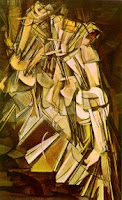
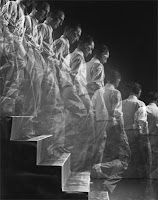
Nude Descending a Staircase (No 2) Duchamp Descending a staircase The Second Life avatar of Tasrill Sieyes

Marcel Duchamp site
Understanding Marcel Duchamp Truly excellent animated timeline of Duchamp's work
tout-fait (online magazine of Duchamp studies)
Jarry, Joyce, Duchamp and Cage a piece from tout-fait
Art Science Research Laboratory (Includes animations of the Rotoreliefs, etc)
Duchamp plus music
Anémic Cinéma film by Duchamp

RAW renewed our interest in the 'Moderns', even though they worked many decades ago, now (and Duchamp didn't come up in conversation) - in particular Joyce and Pound - but (enjoying my ear) I also like the work of John Cage - and he seemed particularly inspired by Duchamp's use of chance in creativity - something also explored by William Burroughs and Laurie Anderson (amongst others). I don't think all these ideas have become dated, yet, or explorations completed! I find particularly intriguing the cross-over inspirations and collaborative work, like Cage's "Roratorio, an Irish Circus on Finnegan's Wake" (1979), and Somewhere between Dream and Reality: Shigeko Kubota’s Reunion with Duchamp and Cage - a wired-up chess set changed the sound scape of the space depending on the moves made by the chess pieces.

"In the nature of the use of chance operations is the belief that all answers answer all questions."
John Cage.

"At a Dada exhibition in Dusseldorf, I was impressed that though Schwitters and Picabia and the others had all become artists with the passing of time, Duchamp's work remained unacceptable as art."
John Cage, Interview, 1973

The Original Trap
The Original Trap "A real coat hanger that I wanted sometime to put on the wall and hang my things on but I never did come to that - so it was on the floor and I would kick it every minute, every time I went out - I got crazy about it and I said the Hell with it, if it wants to stay there and bore me, I'll nail it down… and then the association with the Readymade came and it was that" - Marchand du Sel
Some Other Readymades.

NB: I'd feel stupid discussing 'moderns' from 70 odd years ago, if they hadn't drawn on so-called '19th Century work' like Etienne-Jules Marey, Étude chromo photographique de la locomotion humaine, 1886
I got these simply from development pages of Understanding Duchamp - a true work of love...from Andrew Stafford...although most of us may feel more familiar with the work of Muybridge.


Just found this site - it looks useful: An Encounter with Marcel Duchamp

Thursday, July 19, 2007

Hilaritas!

From Surrealism and it s Others - Yale French Studies - Number 109

As early as 1922, Breton wrote to Jacques Doucet that Duchamp was "the man from whom I would be the most inclined to expect something, if he wasn't so distant and deep down so desperate. " Typical case of transference, for it was Breton who was des­perate to delve programmatically into Duchamp's putative uncon­scious as he did with everyone in the surrealist inner circle. But as com­ments he made in the 1950s, disapproving of Michel Carrouges' study of "bachelor machines" amply indicate, Duchamp gave little credence to the theory of the unconscious. Consequently, Marcel Duchamp's (or, rather Rrose Selavy's) many salacious puns, which to Breton were the most remarkable poetic phenomenon in years, were to Duchamp ex­pressions of fully conscious cognition.

If there was one study on his work that got him really worked up, it was Michel Carrouges' Bachelor Machines, first published with the Ar­canes psychoanalytic publishing house in 1954. And in perfectly anti-­psychoanalytic terms, he made perfectly clear to Breton what got his dander up and just how Carrouges missed the whole point (which was laughter): "Using the Green Box, Carrouges has brought to light the un­derlying process with the meticulousness of a sub-mental dissection. No need to add that his findings, even if they form a coherent whole, were never conscious when I was working out my strategy because my subconscious is mute like all subconsciousnesses and that my strategy had more to do with the conscious need to introduce some 'hilarity' or at least some humor into such a 'serious' subject." Duchamp's under­lining, twice, of the word " conscious" speaks voluminously of his con­viction (that jibes with that of Gertrude Stein, moreover) that there is only consciousness - no unconscious. And his dismissal of Carrouges and his book, Les machines celibataires, could not be more definitive: "For me, there is something other than yes, no, and indifferent - it's the absence of investigations of this sort, for example" ( to Breton, 4 Oc­tober 1954, N° 235).

"Where's Duchamp? - Out Queering the Field" by Robert Harvey

Friday, July 07, 2006

RAW deal

making some real money for the first time in my life...We have had OK reports about Bob's health (good news) but the eBay auctions continue anyway, and one possibility we had considered involved asking Bob to sign some currency of our own devising.

It seemed appropriate, as Bob has a whole routine about money and alternative economies, etc. If Emperor Norton could print his own money we feel that Bob should certainly have that right, too.

In the forums we started gambling with RAW Patatows (or possibly, for the 'Pataphysicians - 'Patatows - spellings do differ) and now Bobby, one of our resident artists, has excelled himself to produce the 'real' thing.no Patatow famine here!

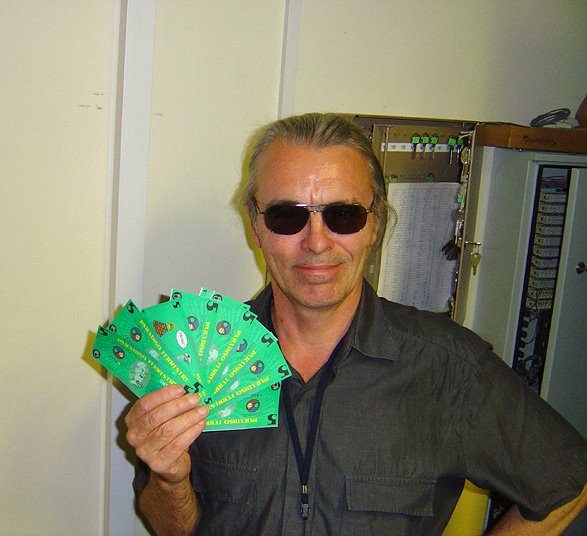
I don't want to show them too large right now (we can't have people forging them! heh heh) but they look just beautiful, both sides...You can now bid for signed ones at eBay, here.
For related material, check out Emperor Norton's homemade dollars, J.S.G. Boggs, Peggy Preheim etc. We don't expect they will raise as much as the dollar bill that Warhol signed, ($340,388) but we'd enjoy it if they did!

Look out for the auction of these truly unique and literally priceless (or valueless?) objects that you can carry in your wallet with your Pope cards, etc.
[update links] Boggs at Wiki.
Boggs and Duchamp - link to following quote from In Boggs We Trust by Olav Velthuis:

Ultimately, the bill is not a dollar at all, at most a representation of it. The bill is real, but the dollar itself is an abstraction… just like God. Indeed, it is remarkable how fundamentally modern monetary systems are grafted onto religion. According to Boggs the invention of both money and God date from the same era, and the traces are still visible in our own days. Just think of the double meaning of words like "redeem," or the root of the word "credit"--it is a direct derivative of the Latin word for believing. The side of Dutch coins reads "God Is With Us," while "In God We Trust" is printed on American bills.

Saturday, January 07, 2006

Don't Quote Me

I enjoy the fact that we have a regular flow of visitors, but at the same time we can’t really expect people to return too often if the content doesn’t change.

Any MLA members who would like to contribute (and this doesn’t have the same pressures as writing a piece for the Maybe Quarterly, as you can always edit or delete your own posts), just contact me to get an invite to become a contributing member, easy as that.

After an initial flurry of activity with several members contributing creative pieces, this seems to have turned into more-or-less my own blog and gossip channel.

I don’t mind as:

I have really enjoyed my 18 months as a member of MLA, and feel happy to enthuse about it

I know that the world has plenty of free forums, so you might wonder why you should have to pay to mingle with this particular crowd, so I think it only fair to try to describe the kind of style you will meet on MLA courses and forums...

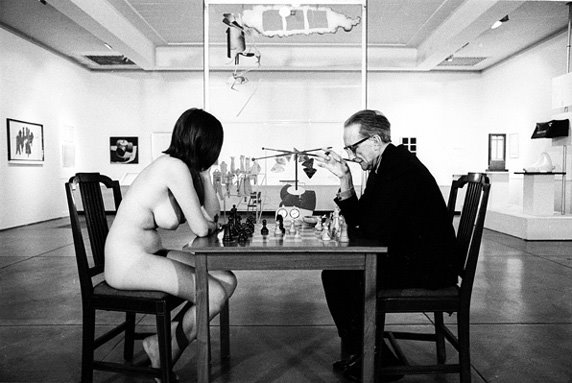
- No, the women don't get to play chess with Marcel Duchamp and no-one gets to play chess with nude women (as far as I know) but outside of that, anything might happen.
I don’t have any guideline or censor to consider, so the whole thing can mutate or die. Things change over time, anyway, and I will happily keep the pages turning until someone else decides to post new words or pictures

Right now I have gone off to explore the (free) Tribe network, and the various groups in there who have similar interests, from General Semantics to Robert Anton Wilson, from Magick and Shamanism to James Joyce. I only hope they don’t see me as trying to hustle up business! I have no investment in MLA beyond my own love of learning and good company.

"Whatever you can do or dream you can, begin it. Boldness has genius, power and magic in it. Begin it now".

—J. W. von Goethe