R.U Sirius sent out links in all directions pointing to the new Spring - magazine. It covers a lot of new terra i personally find very addictive/attractive. And so i wanted to forward the meme h+.
"About h+ Magazine
h+ covers technological, scientific, and cultural trends that are changing — and will change — human beings in fundamental ways. We will be following developments in areas like NBIC (nano-bio-info-cog), longevity, performance enhancement and self-modification, Virtual Reality, "The Singularity," and other areas that both promise and threaten to radically alter our lives and our view of the world and ourselves.
http://www.hplusmagazine.com/

“You should view the world as a conspiracy run by a very closely-knit group of nearly omnipotent people, and you should think of those people as yourself and your friends.” - Robert Anton Wilson
Friday, February 27, 2009

Monday, February 02, 2009
I been Holy Modalled, I been Quetzlcoatl'd
 14 Bahman - Year 1387
I wanted to like this book a lot, I really did. I enjoyed Pinchbeck's first book, Breaking Open The Head, aside from the couple of tedious Burning Man chapters. It seemed to be an honest exploration of psychedelic states of being by a confused, if well-meaning, Manhattan literary party-boy.
I was excited when I first heard that "2012" was being published. I thought it would be a fresh perspective on the whole "end-of-the-Mayan-calendar"/"herald-of-a-new-age" scenario that was first brought to my attention by Terence McKenna and his TimeWave Zero theory. It seemed as if Pinchbeck were stepping up to the plate and was going to pick up where McKenna left off, after McKenna's passing in 2000.
I skimmed some reviews of "2012 - The Return Of Quetzlcoatl" (as the first edition was called)...and many were middling. Undaunted, I thought it was just the cynical contingent of the mainstream press. I checked some reviews over at GoodReads and it seemed to be the same. Hmmm.... Now I realise that anything with "prophecy" in the title (as stated in the edition I have) has the fundamentalist materialists and dogmatic rationalists reaching for their revolvers, but I thought there would be a lot more praise for the book. I decided to finally give it a go.
In "2012", Pinchbeck has devoted his energies to studying the prophecy that a new age will emerge in December 2012, which the Mayan calendar shows as the end of the world, or just the end of the current age, depending on your view. He jets off to Oregon to hang out with Jose Arguelles, who's created a new calendar based on the original Mayan dates. He visits England several times, specifically the Glastonbury area, to study the crop circle phenomenon. Mexico becomes a destination, so Dan can view the Mayan architecture. He goes to Burning Man again (urgh!), but this time the festival isn't so groovy, man--and finally he journeys to the Amazon rain forest, to learn about Santo Daime, a local religion which grafts the disparate strains of old tribal customs and Romish Catholicism into a peculiar ritual. The participants swallow cupfuls of ayahuasca, then sing and do a two-step dance for up to 6 hours.
All the while, he's having relationship problems with his 'partner'. She's never given a name, she's just his partner--though she is described as 'beautiful and svelte' (Pinchbeck wants you to know he's no chubby-chaser). The couple have a child together, which seems ill-advised, as he relates that their union was a bit unstable from the outset. These bits were really where Pinchbeck lost me. In an afterword to the paperback edition, he states how he included all this personal detail to 'invoke a deep enough response in readers that if might incite a shift in perspective'. Erm..that didn't happen for me, mate. It just seemed a bit voyeuristic to me, his tendency to let his audience in on his somewhat private soap-opera, involving his 'partner', another woman he meets at a psychedelic retreat in Hawaii, whom he insists on referring to as "first priestess" (she doesn't have a name either, apparently) and his little girl (again, no name). One chapter is devoted to the partner's father, for no other apparent reason than to compare him to Pinchbeck's own father. He also can't seem to stop exploiting his connection to the Beats (his mother dated Jack Kerouac at the height of his fame), as if that somehow lends him some extra credibility.
In spite of the more frustrating aspects of Pinchbeck's narrative, I did enjoy parts of the book. I really liked the crop circle bits, though I've never really given much thought to the phenomenon, putting down most (if not all) of the designs down to hoaxers. I found myself looking up the various formations Pinchbeck discusses to get a better idea of what he is describing. He didn't convince me with his various theories, but I did think that maybe hoaxers weren't responsible for all of the circles. Some of the Arguelles chapters had interesting segments - but then Pinchbeck inserts some caustic New Yawk intellectual screed, completely dismissing Aleister Crowley, but he buys most of Arguelles' Mayan reincarnation schtick. His visit to the Hopi reservation seems a bit of an anti-climax, but the words of the tribal chief almost redeem the plodding structure of the chapter. The book ends with an eco-warrior message about humanity's destruction of the environment and a possible redemption in the next 6 years (well, it's down to 3 now). Pinchbeck doesn't seem concerned that all of his jetting about might've added to all that pollution....'cos it was like, for the book, man.
So, for all that, you get a somewhat middling book about 2012 and what may happen. For me, it seems a bit of a wasted opportunity--too much about the author, not enough about the actual phenomenon. When he's not talking about his own foibles, he's borrowing ideas from McKenna, Arguelles, Robert Anton Wilson, crop circle devotees and a host of others. It seems that maybe Pinchbeck started believing his own press and yeah, that Rolling Stone article didn't really help things. It appears that he wants to join the psychedelic pantheon and have his name amongst the greats (Wilson, Leary, Huxley, McKenna, Kesey, etc.)--but I just don't know if he makes the cut. Going by "2012", I think he's got a ways to go.
(Cross-posted at Blog Is Not A Four-Letter Word)
Friday, January 30, 2009
DVD of Antero Alli on the 8 Circuit Brain
 In spite of the eclectic interests of this blog, and its authors, we still revolve around some fundamental models, themes and ideas. The 8-Circuit Model that Tim Leary and Robert Anton Wilson evolved - also features in a lot of Antero Alli's work, extended by him in Angel Tech (the book, and the MLA courses).
You can now buy a DVD of Antero delivering a lecture on this material. No review yet (as we haven't seen it) but you might like a link to the page which describes it in more detail, offers viewable excerpts, and has links to further free material on the subject.
You can also purchase the DVD from the same link.
Antero's highly enlightening 8 week interactive online course on Angel Tech will also run again Mar 16 - May 10 2009.
Read the Prospectus here.
See details for this and other courses on the official MLA site.
Or see the general schedule in the public part of the forum.
Note: you can click on the '8 Circuits' Label below to see all previous posts on this subject.
Saturday, January 10, 2009
Finnegans Wake, Cannabis Seeds and a Rottweiler
A Brief cut from my interview with uncle Bob!
[Leading on from some earlier e-mail interview question's you answered for me, can you expand upon why Finnegans Wake, Cannabis seeds and a Rottweiler are essential elements for a 21st century survival kit?]
RAW: You need Finnegans Wake to understand the merging world village that's appearing; Finnegans Wake is the only book that's written from a global perspective, well Pound's Cantos are almost global, they include China , parts of Africa, most of Europe and the United States and some ancient Sumer, Egypt. Joyce is much more universal, he includes a lot more of Africa than Pound does - a hell of a lot more - and a lot more of Asia too. That's part of your education to live in the 21st Century, you gotta master Finnegans Wake, and then you need what? - [Cannabis seeds] - Obvious, that doesn't need any explication does it? And the Rottweiler ....[GAP IN RECORDING WHILE TAPE IS CHANGED]
http://www.maybelogic.org/maybequarterly/08/0801FlyRAWInterview.htm
[Leading on from some earlier e-mail interview question's you answered for me, can you expand upon why Finnegans Wake, Cannabis seeds and a Rottweiler are essential elements for a 21st century survival kit?]
RAW: You need Finnegans Wake to understand the merging world village that's appearing; Finnegans Wake is the only book that's written from a global perspective, well Pound's Cantos are almost global, they include China , parts of Africa, most of Europe and the United States and some ancient Sumer, Egypt. Joyce is much more universal, he includes a lot more of Africa than Pound does - a hell of a lot more - and a lot more of Asia too. That's part of your education to live in the 21st Century, you gotta master Finnegans Wake, and then you need what? - [Cannabis seeds] - Obvious, that doesn't need any explication does it? And the Rottweiler ....[GAP IN RECORDING WHILE TAPE IS CHANGED]
http://www.maybelogic.org/maybequarterly/08/0801FlyRAWInterview.htm
Wednesday, January 07, 2009
ESPionage and magiCIAns
Don't start me talking
I'll tell everything I know
Gonna break up this signifying
Everybody's got to go
Sonny Boy Williamson
Magic of a kindIt’s funny how things come together. I didn't finish this yet, but here's take one...
I like magic (the conjuring tricks of my youth), but have difficulty contemplating magick (the ritual type), which (in spite of the protests of people I know who use it) seems to me like a religious or mystical modeling of the world. Still, they have lots in common (more than either might like to admit) – especially in the area of the manipulation of perceptions and beliefs.

Although a pre-computer geek sub-culture, the magic community has always seemed not so much a secret society as a ‘society with secrets’ (as the Masons also like to consider themselves). The Magic Circle of London has always sounded to me much like a sort of ‘gentleman’s club’ as so many other specialist lodges appear (My grandfather and uncle may have belonged to a masonic ‘music lodge’), but I don’t think it really bears comparison with Masonic groups, even if it shares similar structures (for decades membership remained men only, as initiation you have to perform magic in front of them, they award medals and ranks, and have an Inner Circle, etc. Still, people from all ‘classes’ – remember them? - belong.).
Membership may remain open to all, but it has an elitist quality which does seem to invite the middle classes, the established members of society, the respectable. Similarly, the defence of the realm (the intelligence services) have drawn most of their candidates from Oxbridge (I suspect you will find more John Le Carrés than Harry Palmers).
Magic and spiesAnd the skills of the magician (trickster version) have always figured in secret service skills and interests. The perfect murder? Slipping things into people’s drinks unnoticed? Picking their pocket, extracting information and returning it? Codes and ciphers? Hiding information? Misleading people?

You can find how John Mulholland (a widely respected magician) got involved with spooks, and shared his skills, and is now sometimes vilified by his fellow magicians – for misuse of the arts – in this book.
The MagiCIAn: John Mulholland's Secret Life
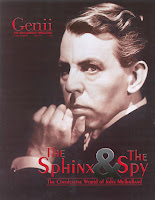
If you don’t want to read a book, this article in Genii (Genii - The Conjuror’s Magazine - April 2001) might do
THE SPHINX AND THE SPY
The Clandestine World of John Mulholland
By Michael Edwards Copyright 2001 by The Genii Corporation. _All Rights Reserved. _
"The manual as it now stands consists of the following five sections:
1. Underlying bases for the successful performance of tricks and the background of the psychological principles by which they operate.
2. Tricks with pills.
3. Tricks with loose solids.
4. Tricks with liquids.5. Tricks by which small objects may be obtained secretly. This section was not considered in my original outline and was suggested subsequently to me. I was, however, able to add it without necessitating extension of the number of weeks requested for the writing. Another completed task not noted in the outline was making models of such equipment as has been described in the manual.""As sections 2,3,4, and 5 were written solely for use by men working alone the manual needs two further sections. One section would give modified, or different, tricks and techniques of performance so that the tricks could be performed by women. The other section would describe tricks suitable for two or more people working in collaboration. In both these proposed sections the tricks would differ considerably from those which have been described.Gottlieb, whose goal was an operational guide that would be of use to agents in the real world, shared Mulholland's view that broadening its scope to include collaborative efforts by teams of operatives or by female agents was well worth the delay. On November 17, he authorized Mulholland to draft the two additional chapters and extended the timeline for completion of the book until May. This new work became MKULTRA Subproject 19…”
Magic, camouflage, dirty tricks and the occult...
And yet Jasper Maskelyne (of a family of British magicians) used his skills to confuse and bemuse the enemy in WW2 and seems to come out of it as a hero. Book: War Magician. Disguising tanks as trucks, and (when necessary) trucks as tanks, moving a whole port city along the coast (by lighting), so bombs fell harmlessly, and all kinds of camouflage and bluff got involved. ‘Dirty Tricks’ still had a glint of wicked deviousness back then.
Ian Fleming, Dennis Wheatley, Graham Greene, John Le Carré – I enjoy to see how much play-acting, fiction, magic and games (from chess to poker) have to do with the world of the spook.

So it almost bemuses me to find espionage doubts and suspicions directed at ‘occult practioners’, too.
Gurdjieff (in James Webb’s The Harmonious Circle);
Crowley (in Secret Agent 666: Aleister Crowley, British Intelligence and the Occult), and even hints about
HPB (Blavatsky) herself - spying for Russia in The Great Game of mystical imperialism (British Empire and Tsarist Russia fighting over central Asia - Tibet, Afghanistan, etc).
Scientific expeditions, or spying?
Early travelers and adventurers sometimes brought back useful maps and information which they perhaps shared if asked, bullied, blackmailed, pressurized, paid, etc. They might even have found it a good way to fund their explorations (as taking a tv crew can today), with upfront payments and commissions.
From the point of view of local peoples, however, foreigners often get treated with suspicion, and if border tensions increase then the unknown may look like military reconnaissance rather than science… Even Wordsworth and Coleridge, poetically wandering in the hills of Somerset (West of England), and conversing in French, were suspected of being spies from the French Revolution (a threat to Britain at the time) and got investigated.
Cells and such
Lone travelers may appear odd enough, but extended networks can come under even more suspicion, as the secretive nature of some business links crime, smuggling, espionage, etc.

Of course, any organisation using a clandestine cellular system has high security but still lays itself open to corruption from within – as a small pocket of members with a different agenda is (by definition) isolated and able to develop its own path and priorities. So I don’t think of all Freemasons as ‘baddies’ (for instance) but I suspect that Freemasonic Lodges do sometimes get taken over (‘turned’), and misdirected from their original course. One example, in Italy and the P2, for instance.
The British secret service apparently ‘turned’ virtually every German agent in the UK during WW2 – and were effectively running the German network, feeding it good, bad or indifferent info and misinfo, etc.
Occult lodges seem a likely target for seeking out and drawing in people, and acquiring influence among intelligent, multi-lingual, well-travelled and perhaps ‘amoral’ people.
Psychic Research

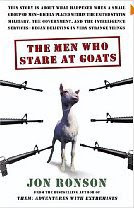
How much of the Russian ‘psychic research’ arose from the Cold War, (secret weapons, black ops, psychological warfare, etc) and how much as genuine scientific research still seems unclear to me, and it turns out the Americans had invested quite a lot of time and money in it, too. Think Puharich and Geller, or Jon Ronson’s The Men Who Stare at Goats.
There are so many threads to pursue. What of the connected stories implicating UFOs, alien abductees, secret experiments, social manipulation of belief systems, and all the other ‘paranoia’ of the ‘conspiracy theorist’ (and those inverted commas show how easily such comments get turned aside)?
Ah, yes, anyway...
When we published Magical Means, we dropped in passing mention of The Great Game (the battle between Brits and Russians over control of India, Tibet, Afghanistan, etc) but perhaps we didn’t take it seriously enough.
[Update: Aug 2014: new material on Houdini as spy in The Secret Life of Houdini]
As in any good scam (or double-cross heist movie), you eventually wonder who controls who...
A few more references:
Joyce Colin Smith – an appreciation of James Webb
In case (like Chris M) you mistake me for a total sceptic about psychic and paranormal 'stuff', can I point you to The Trickster and The Paranormal for an interesting mixed view. Website. Book. Blog.
All my own magic research links can be found on this blog.
Randi's Project Alpha
An interesting edition of the Journal of the Western Mystery Tradition (The Occult and Espionage)
I'll tell everything I know
Gonna break up this signifying
Everybody's got to go
Sonny Boy Williamson
Magic of a kindIt’s funny how things come together. I didn't finish this yet, but here's take one...
I like magic (the conjuring tricks of my youth), but have difficulty contemplating magick (the ritual type), which (in spite of the protests of people I know who use it) seems to me like a religious or mystical modeling of the world. Still, they have lots in common (more than either might like to admit) – especially in the area of the manipulation of perceptions and beliefs.

Although a pre-computer geek sub-culture, the magic community has always seemed not so much a secret society as a ‘society with secrets’ (as the Masons also like to consider themselves). The Magic Circle of London has always sounded to me much like a sort of ‘gentleman’s club’ as so many other specialist lodges appear (My grandfather and uncle may have belonged to a masonic ‘music lodge’), but I don’t think it really bears comparison with Masonic groups, even if it shares similar structures (for decades membership remained men only, as initiation you have to perform magic in front of them, they award medals and ranks, and have an Inner Circle, etc. Still, people from all ‘classes’ – remember them? - belong.).
Membership may remain open to all, but it has an elitist quality which does seem to invite the middle classes, the established members of society, the respectable. Similarly, the defence of the realm (the intelligence services) have drawn most of their candidates from Oxbridge (I suspect you will find more John Le Carrés than Harry Palmers).
Magic and spiesAnd the skills of the magician (trickster version) have always figured in secret service skills and interests. The perfect murder? Slipping things into people’s drinks unnoticed? Picking their pocket, extracting information and returning it? Codes and ciphers? Hiding information? Misleading people?

You can find how John Mulholland (a widely respected magician) got involved with spooks, and shared his skills, and is now sometimes vilified by his fellow magicians – for misuse of the arts – in this book.
The MagiCIAn: John Mulholland's Secret Life
If you don’t want to read a book, this article in Genii (Genii - The Conjuror’s Magazine - April 2001) might do
THE SPHINX AND THE SPY
The Clandestine World of John Mulholland
By Michael Edwards Copyright 2001 by The Genii Corporation. _All Rights Reserved. _

"The manual as it now stands consists of the following five sections:
1. Underlying bases for the successful performance of tricks and the background of the psychological principles by which they operate.
2. Tricks with pills.
3. Tricks with loose solids.
4. Tricks with liquids.5. Tricks by which small objects may be obtained secretly. This section was not considered in my original outline and was suggested subsequently to me. I was, however, able to add it without necessitating extension of the number of weeks requested for the writing. Another completed task not noted in the outline was making models of such equipment as has been described in the manual.""As sections 2,3,4, and 5 were written solely for use by men working alone the manual needs two further sections. One section would give modified, or different, tricks and techniques of performance so that the tricks could be performed by women. The other section would describe tricks suitable for two or more people working in collaboration. In both these proposed sections the tricks would differ considerably from those which have been described.Gottlieb, whose goal was an operational guide that would be of use to agents in the real world, shared Mulholland's view that broadening its scope to include collaborative efforts by teams of operatives or by female agents was well worth the delay. On November 17, he authorized Mulholland to draft the two additional chapters and extended the timeline for completion of the book until May. This new work became MKULTRA Subproject 19…”
Magic, camouflage, dirty tricks and the occult...

And yet Jasper Maskelyne (of a family of British magicians) used his skills to confuse and bemuse the enemy in WW2 and seems to come out of it as a hero. Book: War Magician. Disguising tanks as trucks, and (when necessary) trucks as tanks, moving a whole port city along the coast (by lighting), so bombs fell harmlessly, and all kinds of camouflage and bluff got involved. ‘Dirty Tricks’ still had a glint of wicked deviousness back then.
Ian Fleming, Dennis Wheatley, Graham Greene, John Le Carré – I enjoy to see how much play-acting, fiction, magic and games (from chess to poker) have to do with the world of the spook.

So it almost bemuses me to find espionage doubts and suspicions directed at ‘occult practioners’, too.
Gurdjieff (in James Webb’s The Harmonious Circle);
Crowley (in Secret Agent 666: Aleister Crowley, British Intelligence and the Occult), and even hints about
HPB (Blavatsky) herself - spying for Russia in The Great Game of mystical imperialism (British Empire and Tsarist Russia fighting over central Asia - Tibet, Afghanistan, etc).
Scientific expeditions, or spying?
Early travelers and adventurers sometimes brought back useful maps and information which they perhaps shared if asked, bullied, blackmailed, pressurized, paid, etc. They might even have found it a good way to fund their explorations (as taking a tv crew can today), with upfront payments and commissions.
From the point of view of local peoples, however, foreigners often get treated with suspicion, and if border tensions increase then the unknown may look like military reconnaissance rather than science… Even Wordsworth and Coleridge, poetically wandering in the hills of Somerset (West of England), and conversing in French, were suspected of being spies from the French Revolution (a threat to Britain at the time) and got investigated.
Cells and such
Lone travelers may appear odd enough, but extended networks can come under even more suspicion, as the secretive nature of some business links crime, smuggling, espionage, etc.

Of course, any organisation using a clandestine cellular system has high security but still lays itself open to corruption from within – as a small pocket of members with a different agenda is (by definition) isolated and able to develop its own path and priorities. So I don’t think of all Freemasons as ‘baddies’ (for instance) but I suspect that Freemasonic Lodges do sometimes get taken over (‘turned’), and misdirected from their original course. One example, in Italy and the P2, for instance.
The British secret service apparently ‘turned’ virtually every German agent in the UK during WW2 – and were effectively running the German network, feeding it good, bad or indifferent info and misinfo, etc.
Occult lodges seem a likely target for seeking out and drawing in people, and acquiring influence among intelligent, multi-lingual, well-travelled and perhaps ‘amoral’ people.
Psychic Research

How much of the Russian ‘psychic research’ arose from the Cold War, (secret weapons, black ops, psychological warfare, etc) and how much as genuine scientific research still seems unclear to me, and it turns out the Americans had invested quite a lot of time and money in it, too. Think Puharich and Geller, or Jon Ronson’s The Men Who Stare at Goats.

There are so many threads to pursue. What of the connected stories implicating UFOs, alien abductees, secret experiments, social manipulation of belief systems, and all the other ‘paranoia’ of the ‘conspiracy theorist’ (and those inverted commas show how easily such comments get turned aside)?
Ah, yes, anyway...
When we published Magical Means, we dropped in passing mention of The Great Game (the battle between Brits and Russians over control of India, Tibet, Afghanistan, etc) but perhaps we didn’t take it seriously enough.
[Update: Aug 2014: new material on Houdini as spy in The Secret Life of Houdini]
As in any good scam (or double-cross heist movie), you eventually wonder who controls who...
A few more references:
Joyce Colin Smith – an appreciation of James Webb
In case (like Chris M) you mistake me for a total sceptic about psychic and paranormal 'stuff', can I point you to The Trickster and The Paranormal for an interesting mixed view. Website. Book. Blog.
All my own magic research links can be found on this blog.
Randi's Project Alpha
An interesting edition of the Journal of the Western Mystery Tradition (The Occult and Espionage)
Subscribe to:
Posts (Atom)