Webring

Member of the NEW TRAJECTORIES webring

Thursday, July 28, 2005

mind spread out

inside this body

electro neuro spirits spoke
so it happens
I made a call on the home phone line away
translated in relation to anything
added up to previous complicated selves

conversation faded out
its time to go back but this seem interesting enough
three cop cars are in the parking lot
eating the surroundings
drinking the falling sky
listening closely
traveling back in time

Saturday, July 16, 2005


meta for calli
evolutions
calling upon thee compass to spin

soon all the scallops from cape cod will be chattering
bills will billow away
growing larger and smaller

Thursday, July 07, 2005

The Third Degree

Having just read Jesus and the Goddess - due to my weakness for Gnostic interpretations of the world - I came across the distinction between the various initiatory levels. Specifically, the Psychic Initiation (baptism) and the Pneumatic initiation (here listed as crucifixion) - leading to the Fiery Initiation to true Gnosis - which I might define not as 'knowledge' of some specific thing, more an 'appreciation of the scale of the mystery'. This didn't entirely match a map I had used before...

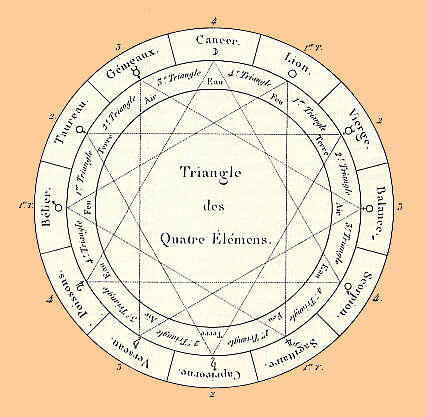
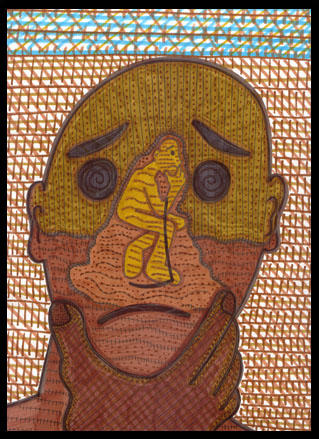
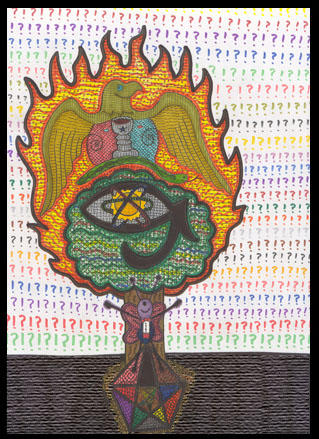
Metachor, Bobby and I had discussed this stuff with other MLA members in a fascinating thread in the Old Forum (you have to join the MLA to read it all). Bobby did some illustrations, but we never quite tied it into a finished piece. Finally, here they are (you can see them larger over at Buddhafart).
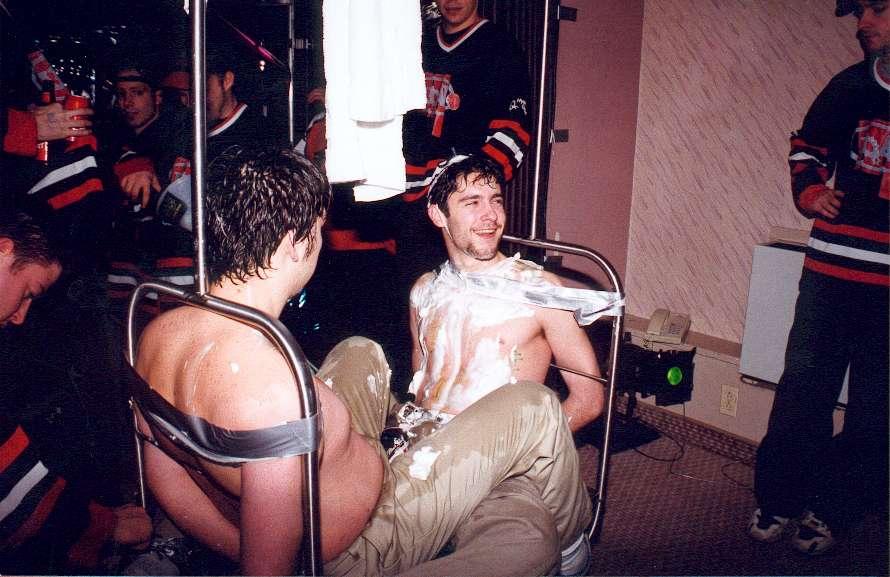
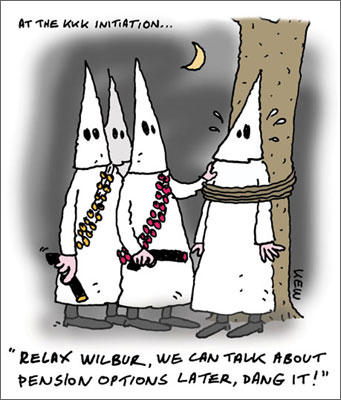
Initiations often involve suffering or sacrifice, either physical or mental ordeals. Some (like hazing ceremonies) seem like just self-perpetuating group bonding (Hell's Angels, body piercers, etc).
Others relate to threshold crossing (weddings, bar-mitzvahs, funerals, circumcision, etc). Only a few seem directly related to consciousness and access to hidden knowledge.
I'll leave you to decide (or find out) if Masons, Witches or Magickians offer genuine insight through their initiations, or just membership of a club.


I liked this 'elements' model because I could relate it to many of these kinds of initiation - being stripped down, clean and simple, easily visualised - and yet it felt atmospheric and evocative to the imagination. The Elements already form an important part of the psychological knowledge stored in astrological studies, and the medaeval theory of the Humours. Arthur M Young has some interesting stuff to say on Elements and Maps, if you have 30 minutes to listen.
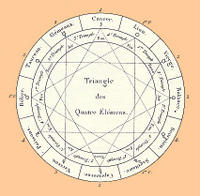
Three Degrees of Initiation and Four Elements.
As with mosbunall symbol systems the material may seem highly compressed, and can be unzipped and expanded almost indefinitely. The most interesting aspect of Colin Still's model, to me, was that it didn’t only refer to the four elements, but to the three transitional stages (a concept I found most useful).


FIRE
Rainbow / Veil/ The Third Degree - Death or Simulated Death
AIR
Mist/ The Second Degree - Overcoming Confusion
WATER
Mud/Clay/ The First Degree - Purification
EARTH

Traditionally people used an up/down model (earth/heaven), but I prefer to think in Bucky's terms of outward/inward. So spacetime compressed down to a material Earth plane, but we can always expand back out to encompass it all. This map can show both The Fall into matter, and The Initiations as a way of escape.

Light/Fire/Energy/Vision appears as the source in most religions. Next emerges The Word / The Great Thought / A Sound / OM (Air) and ‘being’ gets drawn from the Higher Paradise to the Lower (lesser) Paradise of Air...after passing through the veil...to manifest in a ‘Spiritual’ Body (Spiritus – Air - Pneuma - Breath). This ‘being’, tempted by desires and passions, descends through the confusion and purgatory of mist (mixture of air and water – muddled thinking) into a ‘Psychic’ Body (Water) of Time and Emotion. The 'being' travels over the River Lethe (forgetfulness of origins) and finally is dragged down by the mud and mire (between water and earth) - sometimes meeting spirits in the shape of hounds – and from that clay a physical body manifests (Earth), or if you prefer, a body gets ‘put on’ like a suit of clothes.
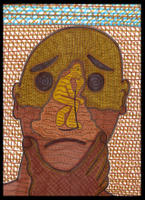
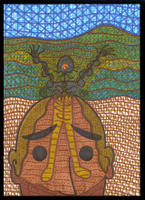
To escape from this mundane level the 1st Degree Initiation or ordeal involves katharsis (cleansing), Baptism (Xianity), or Purification - washing the mud off, crossing the River Styx, passing Cerberus - the Guardian of the Threshold in the form of a 3-headed dog - seeing beyond the animal body, etc.
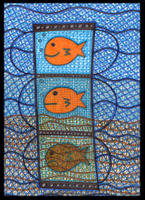

We emerge into the Psychic Realm of Water...an awareness of time and mystery (clairvoyance, prediction, memories, etc). Many people remain in that faith-based realm of Soul.
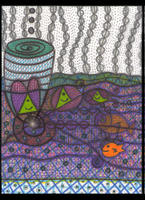

The 2nd Degree involves seeking gropingly through mist, steam or fog (mixtures of water and air - emotional, non-rational, thinking) – but the theme of being lost or confused also relates to mazes and wandering in the wilderness. One has to confront the Dragon of desire, the tempter; the Sirens of memories and alluring thoughts and fantasies; the Monsters of doubt and fear. The help you may receive comes in the form of the transmission of words of inspiration, (Xian) Confirmation.

If you overcome the monsters and temptations, and do not fall back – then you can emerge into the clear calm air of space, and rational thought - The Word and the spirit (Latin: spiritus=breath, inspiration, etc) and pneuma (Greek: wind) – the lower paradise or Elysium - and maybe hang out with the angels (whoever you perceive them as).
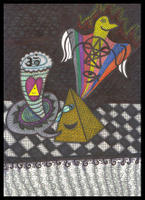

One further step remains. One further Initiation. To go from Air to Fire, from the Lower to the Celestial Paradise, you have to ‘cross the rainbow bridge’, to pass through the Ring of Fire or The Veil or the Ring-Pass-Not, in different traditions. The Third Degree’s ordeal involves a Simulated Death, or a series of labours that must be endured...a final illusion to overcome.
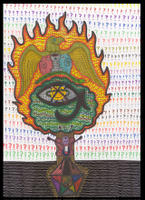
This final state of pure energy gets described as Fire, Light and Energy - and in most traditions the descriptions involve visual terms – Enlightenment – Vision – Revelation - Illumination, etc.

So I have given you the basic map. Of course, it works on many levels – and people may quibble about how Air can be both thought and spirit. Sombunall of us think of rational thought as being directly opposed to ‘spiritual’ matters, but if you look at religion (and particularly Catholic or Charismatic or New Age stuff) you can see that all those kind of beliefs belong to the Soul – Emotions – Impressions - Psyche and the generally non-rational ‘sensitive chaos’ of Water. Air represents ‘mind’ and 'spirit' in their higher sense...exchange of ideas, inspiration, transmission – the calm detachment we see in (say) The Dalai Lama.

In Colin Still’s book he sets out this map, and then explains how (subliminally) these themes are expressed in Shakespeare’s The Tempest – and hopes to indicate its relationship to the old Mystery Traditions, in which some characters fail the tests (and fall back) and some pass.
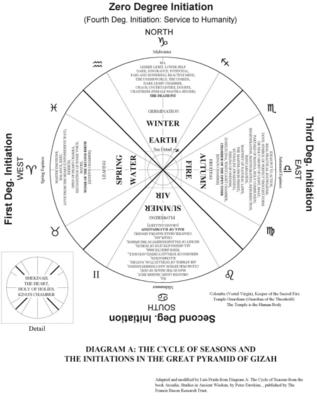
This brief summary does not begin to do the map justice, of course. I mentioned the traditional ‘river-crossings’ because in (say) the Greek Myths mosbunall of us revolve from Earth to Water and then are tempted back to Earth, etc. and get stuck in that uninspired cycle. I found a really interesting take on this - relating it to Egyptian Initiations, and completing the cycle. Go to this page, and scroll to the bottom...

Whenever you attempt to combine all systems into one unified system you may expose anomalies. The associations do not always match. You may consider the same map useful within one lifetime, or as a reincarnational map, or as a guide to myths and legends and Joseph Campbell's monomyth, or as a way of understanding Initiatory levels. Still, I hope that, whatever you use it for, you will find this simple elemental map evocative and useful.

Tuesday, July 05, 2005

Evaluating the 8-Circuit Model

Through his research in developmental psychology and personality theory, Dr. Timothy Leary synthesized a model of different layers of psychological and cognitive activity in human beings, as delineated by the stages of "imprint vulnerability" in developing individuals (cf. Erikson developmental stages: Infant, toddler, preschooler, etc.) This 8-Circuit model finds further expression in the writings of Robert Anton Wilson. He uses this model to describe how individuals come to possess their own unique "reality tunnel," or gloss or world-view, and how individuals and groups interact and communicate (or miscommunicate) with one another through their differing reality tunnels.

The 8-Circuit model gets a bit of currency among students of the Maybe Logic Academy, as a significant tool for parsing events and ideas to better understand how they affect, and are affected by, the psychology and character structure of people.

For example, the 2nd circuit, the Emotional-territorial circuit, deals with mammalian political territorial struggles and personal emotional demands in a group setting. Examples are the top-dog/bottom-dog dynamics in packs of dogs, or a primate habit of resolving territorial disputes by flinging excrement at one another. When watching two human politicians shouting invectives (debating) on television, we can classify their behavior under the 2nd circuit.

Questions sometimes arise as to which of the different layers should be used when analyzing a particular process or idea. Two points could be kept in mind. First, the processes and events that actually happen (i.e. not just our internal representations of those processes and events) have a complex and multi-dimensional nature that becomes simplified as we model them in our knowledge. To ask on which one circuit a particular process occurrs overlooks the multiple layers to which a process relates, as well as the interactions and feedback between layers. Second, but more importantly, we must remind ourselves that "the map is not the territory." The 8-Circuit model only provides a filter for referring to experiential events, and any identification between parts of that model and the actual events being analyzed results from an error on the part of the user.

By way of illustration, if I were to say "Getting into a fight with my parents because I died my hair pink before going to Church is a 2nd-circuit emotional-territorial issue," I ignore both these points and risk semantic confusion. Besides territorial issues of parental authority, we could look at 3rd-circuit semantic issues of symbolic-proficiency and adult-identity formation ("Can I verbally justify my autonomy to die my hair?") and 4th-circuit socio-sexual issues of cultural norms and customs ("This Church is a part of the culture I was raised in, and has certain expectations for appropriate dress/looks"). And none of these different "circuits" is the same thing as what was personally experienced, but hopefully serve as detailed maps for orienting and navigating myself with respect to the experience.

In the past year I constructed two diagrams that combine the 8-Circuit model with other mapping systems, with the aim of finding isomorphisms (or deep structural similarities) between these various systems. My first attempt combines the 8-Circuit model with the Tree of Life of the Hebrew Qabala and with the Chakras of Hindu mysticism. This demonstrates a non-linear, forked and stacked representation of the layers and their interconnections.

Free Image Hosting at www.ImageShack.us

My second attempt combines the 8-Circuit model (and vestiges of my first diagram) with the Open Systems Interconnect model for computer network protocols and with a preliminary model for human communication based on my own research in cybernetics, semiotics and "connectionist" artificial intelligence.

Free Image Hosting at www.ImageShack.us


These organic maps represent past iterations of a running process of developing my own personalized synthesis among a large number of mapping systems including the 8-Circuit model. Every day I re-evaluate these meta-maps, as I come to integrate new experiences into my personal models and to interact with new people and ideas.

Because of the stature of the 8-Circuit model as a diagnostic tool in the Maybe Logic community, I post these ruminations here with the hope that we can further develop our understanding of them as a community.

Different Kinds of Magic

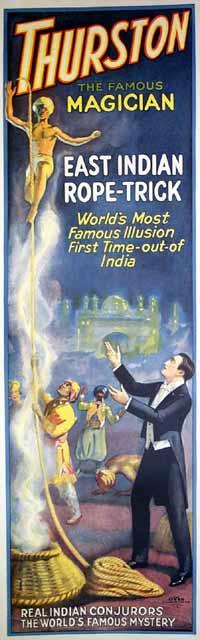
As I often find human imagination more interesting than reality checks, I have really enjoyed Peter Lamont's "The Rise of the Indian Rope Trick: the biography of a legend", OR "How a Spectacular Hoax Became History".

First of all, he knows of which he speaks. He has trained as a magician (conjuror style), and as a historian, has also worked as a psychic and and he take a parapsychologist's position of careful study of the events and effects perceived by people rather than hasty judgement about the methods / causes.

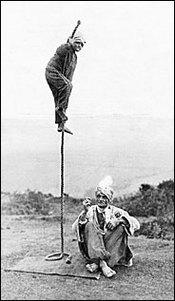
I found this book enlightening about both human creativity and gullibility. This famous trick, for which most of us have a vivid mental image, appears to have never been performed as described, outside of a theatre. The well-known version started as a newspaper hoax, which picked up accretions of travellers' tales, and legends with similar elements, combined with the hyperbole of Victorian performers, Europe's fascination with 'the mystical East', the competition between unscrupulous newspapers, many humans' delight in self-publicity, some bad historical research, many improbable explanations, and later 'offered rewards' and we ended up with this vivid impression of something that never actually happened.

A throwaway newspaper item written by a man who (by chance) would end up as head of the secret service - although he can hardly have invented any more effective piece of misinformation than this in his whole career (unless he started the UFO thing!)

I remain far more interested in these secular versions of magic, than in the Harry Potter or Aleister Crowley forms, which claim to involve 'real magic'- whatever that means (not to say that yoga and visualisation exercises don't contribute to a healthier functioning bodymind).
Punter: "Did you see the bloke on tv last night, bending spoons with his mind?"
Me: "Yeh, but I've seen a guy working restaurant tables doing the same thing."
Punter: "OK, but that's just a trick. This guy does it for real!"
Me: (sigh)
Still, these books may help:

Modern Enchantments: The Cultural Power of Secular Magic Simon During
Here's a Review from the Guardian
In Simon During's new study of the history and significance of secular magic, Fawkes is a key figure. It was precisely his insistence - and that of those who followed - that there was nothing supernatural up his sleeve that allowed secular magic to be redefined as entertainment and performance and thus distinguished from "natural" magic on the one hand (what we'd now call science, or proto-science, or alchemy) and "power" or "real" magic on the other (what we might call "Frazerian" magic, the art of manipulating an audience into a set of beliefs and behaviours on the basis - usually - of an appeal to some transcendental construct, whether deity, spirit or ideal).
And here's a slightly more academic one
During does discuss spiritualism and ‘natural’ magic extensively – particularly with regard to their constant exchanges with secular magic (often involving the same performers) - but spiritualism and other forms of magics are only there to give a context for the secular magic that interests him. This stringent drawing out of the secular within magic makes for a very different book to others more concerned with the persistence of magic and superstition within culture (such as Erik Davis’ Techgnosis, David Noble’s The Religion of Technology, or Jeffrey Sconce’s Haunted Media). Taking the path through the secular within magic also enables During to outline a very different cultural power found within magic.
Believing in Magic: The Psychology of Superstition Stuart A. Vyse
Although we live in a technologically advanced society, superstition is as widespread as it has ever been. Far from limited to athletes and actors, superstitious beliefs are common among people of all occupations and every educational and income level. Here, Stuart Vyse investigates our proclivity towards these irrational beliefs. Superstitions, he writes, are the natural result of several well-understood psychological processes, including our human sensitivity to coincidence, a penchant for developing rituals to fill time (to battle nerves, impatience, or both), our efforts to cope with uncertainty, the need for control, and more. Vyse examines current behavioural research to demonstrate how complex and paradoxical human behaviour can be understood through scientific investigation, while he addresses the personality features associated with superstition and the roles of superstitious beliefs in actions. Although superstition is a normal part of human culture, Vyse argues that we must provide alternative methods of coping with life's uncertainties by teaching decision analysis, promoting science education, and challenging ourselves to critically evaluate the sources of our beliefs.
Magic in Theory Peter Lamont & Richard Wiseman
Magic, properly performed, is a complex and skilful art, and is capable of deceiving anyone. One of the reasons why so little information is available to non-magicians interested in the topic is that magicians are understandably relectant to expose conjuring methods. Magic is a secretive business. Psychologists have long recognised that they may have much to learn from the techniques used by magicians to fool their audiences. Parapsychologists are aware that many individuals claiming to be psychic use magic tricks to fabricate paranormal phenomena. Failure to detect such fraud can lead to serious consequences, including loss of funding and negative publicity. Greater theoretical understanding of conjuring and psychic fraud will raise awareness of how vulnerable observers can be. Parapsychologists, psychologists and magicians have all written about the strategems that lie behind successful conjuring. Each has approached the topic from different viewpoints. This book is an attempt to draw together these different theoretical approaches and present them in a way that is accessible to a non-technical readership. It is partly based on interviews conducted with present-day magicians, many of who are internationally recognized by the magical fraternity for their insight into conjuring psychology and theory.
Straight Dope on Rope: Cecil often makes interesting points, and the Skeptics Dictionary has some great material.
As boring old PSICOP sceptics like Martin Gardner may not impress you magickians, and slightly pompous old farts like The Amazing Randi may not entirely convince you that all psychic workers use the methods of confidence tricksters and magicians, I would refer you to Penn and Teller as modern secular magicians who remain truly sceptical.
Penn & Teller in India. They did find an Indian magician who would make a rope stand on end firmly enough for a small boy to climb a few feet up it, but that's all. No disappearance, no dismemberment. Respect for trying. Someone tried to get away with this minimum performance and claim The Magic Circle's reward many years ago, back when 'blacking-up' did not seem offensive and humiliating.